

Justin Benner was rolling around in a flowerbed outside his next-door neighbor’s house late at night, yelling “help him” and “she’s got a gun,” when Tulsa police officers arrived. No one else was around.
When Benner did not respond to commands, an officer shot him with a pepperball gun and pinned him down with a tactical shield. Police officers dragged him to a patrol car.
Earlier that day in September 2025, the 48-year-old’s father had taken him to a psychiatric clinic after he began acting paranoid, but doctors cleared him to return home.
Tulsa Police Department policy requires officers to take people for a medical assessment when they appear to need treatment for serious mental illness. Instead, officers arrested Benner for public intoxication and resisting arrest and took him to the Tulsa Municipal Jail, a small downtown lockup with no on-site medical staff.
Support The Frontier
Help fund investigations like this one
The Frontier is a nonprofit newsroom. Your donation pays reporters to investigate powerful institutions across Oklahoma.
Become a donorThere, detention officers didn’t conduct a required medical screening before wrenching Benner into a full-body restraint device as he groaned and pleaded for help. As staff closed the door to Benner’s cell, he began to writhe and shake, surveillance video shows. Less than an hour later, he was dead.
A Frontier investigation in March found Benner was one of at least seven people who have died from preventable causes at the city lockup since 2023. The reporting found that the facility, which only holds people on low-level misdemeanor charges, has repeatedly accepted medically fragile arrestees in violation of jail policies and despite repeated warnings from city and jail staff.

Newly obtained jail surveillance video, internal reports, and police body camera footage from Benner’s case provide the first detailed look at one of the deaths. City officials have blocked The Frontier‘s access to records related to the city jail, and the news organization is contesting those denials with attorneys from the Reporters Committee for Freedom of the Press.
Medical examiners could not determine whether Benner died of natural causes, homicide, an accident or another manner of death, according to an autopsy released in April. The report listed heart disease, being restrained, physical trauma and methylphenidate — a common medication Benner was prescribed for attention deficit disorder — as factors that may have contributed to his death.
Benner, a graduate of Oklahoma State University, worked as a chef and had no criminal record, other than a DUI more than 14 years ago.
“He was the nicest, most giving and caring soul you’d ever meet,” said Melanie Seigfried, a friend who had known Benner since middle school. “He would give the shirt off his back for anybody and put everybody else before himself.”
Benner had completed treatment for alcoholism years earlier but had no history of severe mental illness, his father, Benjamin Benner, said in an interview. Even though he was arrested on a complaint of public intoxication, his father said he believes his son was sober that day. The autopsy found only a low dose of his ADHD medication in his system.
Allied Universal, a multinational security firm the city pays to operate the jail, did not respond to requests for comment. The Tulsa Police Department referred questions to the City of Tulsa, which declined to comment due to potential litigation.
‘Pour some water on his face at the jail and call it good’
Officers initially planned to take Benner to Tulsa County’s David L. Moss Criminal Justice Center after he told them he was a tribal citizen. Unlike the city jail, the county jail has agreements with tribes to hold their arrestees. It also employs medical staff who screen people for medical conditions during booking.
A police supervisor predicted the county would require Benner to be medically evaluated at a hospital before they would accept him.
Viewer discretion advised: This video contains body camera footage and scenes that some viewers may find disturbing. It is presented because it is central to understanding the circumstances surrounding Justin Benner’s death and The Frontier’s reporting on the Tulsa Municipal Jail.
“I see a med clear in your future,” the supervisor said.
“Oh lordy. I’ll get me some overtime tonight,” one of the others replied.
But police determined Benner was not enrolled as a tribal citizen, which meant he could be taken to the Tulsa Municipal Jail instead.
Tulsa officials created the city jail in part to reduce the time police spend booking arrestees into the county jail, where officers can be waylaid for hours when they have to take arrestees to the hospital.
Tulsa Police Department policy requires officers to call medics when someone shows signs of medical distress before or after officers use force. The officers called Tulsa Fire Department paramedics to the scene but waved them off when they arrived.
“He’s got a scraped-up knee and that’s about it,” an officer said.
The police supervisor then told the officers: “I’d just haul him down there like that. Pour some water on his face at the jail and call it good.”
The officers had been called to Benner’s neighborhood in midtown Tulsa after his next-door neighbors heard a commotion in their yard. In the darkness, they didn’t realize it was Benner until police arrived and lit up the scene.
Deaths inside Tulsa’s city jail
At least seven people died after being detained on low-level charges. Our reporting uncovered inadequate medical care, ignored warnings and a lack of public accountability.
They were arrested for misdemeanors. Then they died in Tulsa’s city jail.
The Frontier found a pattern of preventable deaths, inadequate medical care and ignored warnings inside Tulsa’s municipal lockup.
Read the investigation → Key findingsAt the Tulsa city jail, preventable deaths and hidden records
Five things to know about detainee deaths, medical care, oversight and secrecy at the underground city jail.
Explore the findings →When officers said they planned to take him to jail, the neighbors became alarmed.
“Now I feel terrible. He’s needing some serious help right now,” one neighbor told an officer. “I feel awful now. I don’t want him to go to jail.”
The officer reassured them: “Luckily, we’re in a position where we can kind of get him the help that he needs. At the very least, in jail they have the stuff for that.”
Minutes later, Benner rode handcuffed in the back of a Tulsa police cruiser as the heavy metal band Lamb of God blasted through the car stereo during the drive downtown.
At the windowless city jail, staff were waiting with a full-body restraint known as “the WRAP.”
Restrained and left alone in a cell
Benner groaned, trembled, gagged, and said “help me” as three detention officers wrestled him into the restraint device, police body camera footage shows. At one point, a detention officer knelt on his back.
The yellow and black, mummy-like WRAP device immobilizes a person with their legs extended inside a padded sleeve while straps bind the torso. Once strapped in, a person cannot shift position, extend their limbs or slump if their breathing or medical condition deteriorates, the manufacturer’s manual states.
The manual warns that “timely evaluation of the subject for medical needs is critical to reducing health risks and preserving life” and instructs staff to seek immediate medical attention if a person shows signs of ailments including “emotional distress,” “gagging,” and “suspected drug behavior.”
As he was being strapped in, the arresting officer photographed welts on Benner’s face from pepperballs and wounds on his knees for an internal police use-of-force report. Detention officers never conducted a medical questionnaire required by state law for all jail inmates “immediately upon admission.”
As detention officers carried Benner into a holding cell, one asked what drugs he was on. “Probably meth,” a police officer said.
Laid on his side, Benner began to shake and grimace as detention officers closed the door of his cell and covered its window with a curtain. After about 15 minutes, Benner stopped moving. Surveillance video shows a detention officer looking into the cell after 20 minutes and motioning for a police officer and another jail worker. Both looked in the cell, but no one entered to check on Benner.
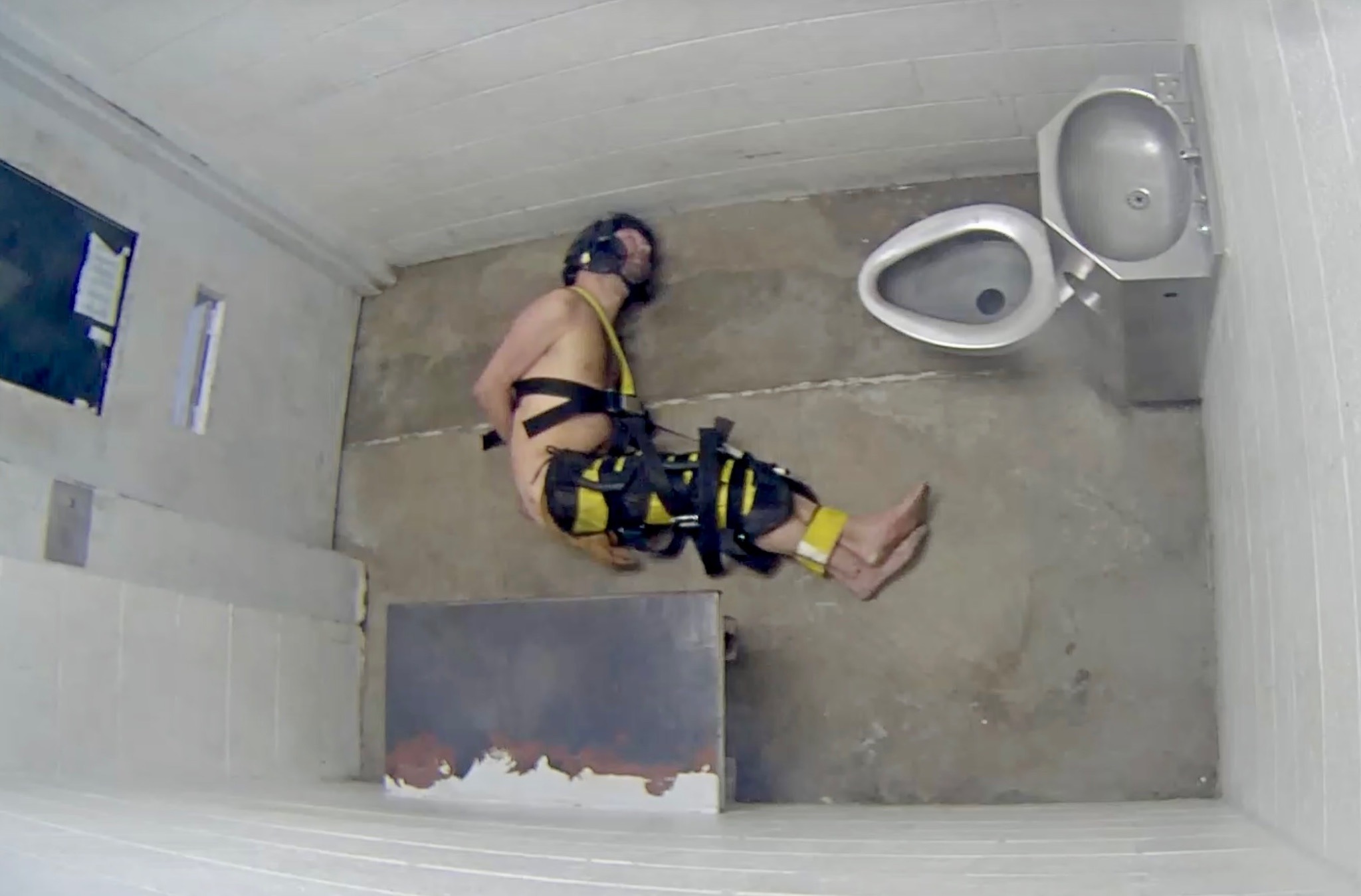
After 54 minutes, a supervisor monitoring the jail’s surveillance video feed noticed Benner hadn’t moved in a while and asked a detention officer to check on him. She found him unresponsive.
Believing Benner had overdosed, detention officers administered Narcan. When it had no effect, they hurried to free Benner from the device and tried to resuscitate him, but it was too late. Paramedics declared Benner dead when they arrived.
After the incident, a police officer told colleagues that jail staff weren’t sure what to do when they found Benner unresponsive.
“The staff was in there standing there like ‘I don’t know what to do.’ And so I walk over and I was like ‘well, he doesn’t have a pulse so start CPR,’” the officer said. He said he also showed them how to use the automated external defibrillator, or AED.
Officers also discussed the WRAP: “I wonder why they’d leave him in the WRAP,” one said.
“That ain’t my business either,” another responded.
The autopsy documented extensive injuries across Benner’s body, including broken ribs, bruised lungs and internal bleeding around his throat and aorta. The autopsy report says some injuries could have resulted from efforts to resuscitate him.
The Oklahoma State Department of Health found the city violated no state jail standards in Benner’s death. But the agency’s investigations are usually cursory. In Benner’s case, investigators reviewed “facility incident reports” and jail policies but conducted no interviews with staff or other witnesses, according to a Health Department investigative report.
When someone dies at the city jail, the Tulsa Police Department — which oversees the facility — is also the agency that investigates potential criminal wrongdoing. The city told The Frontier in March that Tulsa police investigators found no violations of policies or the law in connection with any deaths at the jail, including Benner’s. Tulsa Mayor Monroe Nichols, however, said he opened an “additional review” in response to The Frontier‘s reporting. A city spokesperson said the investigation is now complete, but has not responded to questions about its findings.
‘It can happen to anyone’
Benner’s father described him as an endlessly curious, compassionate and generous person who loved the outdoors and maintained a close-knit circle of friends. In the weeks before his death, he had been attending job fairs and looking for new work.
“He was a gentle soul,” his father said. “He wouldn’t mow his backyard if there were rabbits out there because he was afraid he was going to hurt them.”
Nearly a year after his death, Benner’s family is preparing to seek further answers in court. They have retained Tulsa civil rights attorney Daniel Smolen to pursue a wrongful death lawsuit on their behalf.
Smolen himself has a personal connection to the case: He and Benner attended Cascia Hall High School together and remained part of the same circles of friends for decades.
“Justin was one of the kindest guys. He’d just hug you. He was a hugger,” Smolen said. “If this can happen to Justin, it can happen to anyone.”


Garrett Yalch was hired in 2024, joining The Frontier’s Tulsa newsroom. He covers corporate and government accountability issues, with a focus on the Tulsa area. He can be reached at Garrett@readfrontier.com