

The Trump administration’s plans to build a massive smelter in Inola to revive the U.S. aluminum industry have generated big claims about how clean or dirty the operation would be, how many jobs it could create and the company Oklahoma Primary Aluminum’s foreign ties. But there are still many unknowns about the facility, including how much pollution it would actually generate.
Mike Mazzei, who is running for governor, secured President Donald Trump’s endorsement after proclaiming his support for the smelter project. Oklahoma Attorney General Gentner Drummond, who narrowly lost the Republican nomination to Mazzei, is suing to block construction of the smelter.
We reviewed some of the recent claims about the smelter and evaluated their accuracy using public records, interviews and other sources.
Claim: The Inola smelter would be the largest in the world.
Source: “Now we’re going to have the largest aluminum plant in the world being built in Oklahoma,” President Donald Trump said during a NATO summit in Turkey in July. “It’s a great state. They’re gonna be building the largest aluminum plant in the entire world in Oklahoma starting very soon.”
Fact check: False
The Inola smelter could produce up to 750,000 metric tons of aluminum per year, according to Oklahoma Primary Aluminum. It would be the largest primary aluminum plant in the United States, but there are larger smelters in other parts of the world. Bahrain’s Alba smelter produced over 1.6 million metric tons of aluminum in 2025. The Vedanta Aluminum plant in Jharsuguda, India can produce up to 1.8 million metric tons per year.
-Brianna Bailey
Claim: The smelter will create 10,000 jobs.
Source: “It’s great to have 10,000 jobs that will benefit northeastern Oklahoma, but we will make sure it’s 100% safe and successful,” Mike Mazzei said during a campaign appearance in Tulsa in August.
Fact check: Mixed
Estimates vary on how many jobs the Inola smelter could generate.
The smelter would create about 1,000 permanent jobs at the facility, but Oklahoma Primary Aluminum says the project could generate as many as 14,000 total jobs, a figure that includes 9,000 secondary jobs and 4,000 construction jobs.
The Oklahoma Department of Commerce said the smelter could create about 10,000 jobs. That estimate includes 800 indirect jobs through spending on services and equipment for the project and another 3,300 downstream jobs for things like refining, distributing and professional services.
The agency said it couldn’t provide a written report on how it conducted its job creation analysis for the plant.
“That analysis was done by our research team looking at the numbers and doing the math,” Chase Horn, a spokesperson for the Department of Commerce, said in an email.
-Brianna Bailey
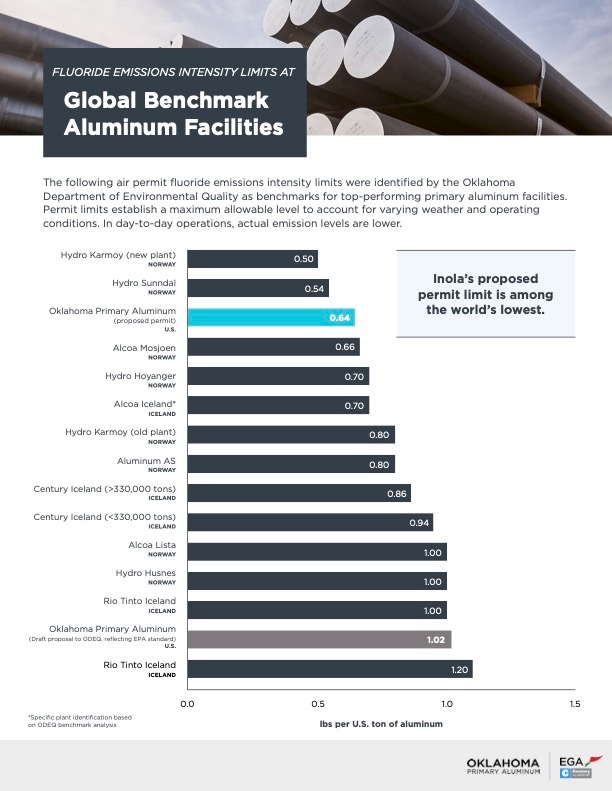
Claim: The Inola smelter’s proposed emission limits would be among the world’s lowest.
Source: Oklahoma Primary Aluminum claimed that Inola’s proposed permit limits would be “among the world’s lowest” in a Sept. 3 press release announcing that it would seek reduced emission limits at the Inola smelter. The release included a chart comparing the proposed emission limits to other smelters in Norway, Iceland and the United States.
Fact Check: Mixed
The company says it can reduce its fluoride emissions at the Inola smelter by more than a third with state-of-the-art technology and other safeguards. Oklahoma Primary Aluminum is asking regulators for permission to emit no more than 0.64 pounds of fluoride per U.S. ton of aluminum it would produce in Inola. That would be “lower than the limits set for 9 out of the 11 top international facilities” state regulators have identified, the company said in the Sept. 3 press release.
While the company says it will reduce its emissions rate, many of the smelters the company referenced in its comparison are smaller and produce less aluminum than the facility Oklahoma Primary Aluminum wants to build in Inola. The Alcoa Mosjoen smelter in Norway, with an emissions rate of 0.66 pounds per ton, has a capacity to produce 200,000 metric tons of aluminum per year, compared to the Inola smelter’s proposed capacity of 750,000 metric tons per year. The Rio Tinto smelter in Iceland, which has the highest emissions rate on the list, produces about 210,000 metric tons of aluminum per year.
Oklahoma Primary Aluminum said in response to questions that measuring the rate of emissions is the industry standard to evaluate performance.
“We have proposed by far the lowest fluoride emissions intensity limit of any primary aluminum plant in the United States and among the lowest in the world,” the company said. “While total volume naturally scales with overall production capacity, a larger facility footprint does not equate to greater environmental impact when state-of-the-art reduction technology and capture systems are utilized.”
-Brianna Bailey
Support The Frontier
Help fund investigations like this one
The Frontier is a nonprofit newsroom. Your donation pays reporters to investigate powerful institutions across Oklahoma.
Become a donorClaim: Two private ventures are behind the smelter, “one of which is owned by the government of an Islamic Foreign monarchy.”
Source: “The controlling hand behind the largest smelter ever proposed on American soil belongs not to Oklahomans, nor even to Americans, but to a foreign sovereign more than 7,000 miles away,” Drummond wrote in a June legal filing.
Fact check: True
Emirates Global Aluminium and Century Aluminum Company are the two companies behind the aluminum smelter project planned for Inola. Emirates Global Aluminium owns 60% of the joint venture, while Century Aluminum owns 40%, according to the Oklahoma Department of Commerce.
Emirates Global Aluminium is owned by two sovereign wealth funds of the governments of Dubai and Abu Dhabi.
-Kayla Branch

Claim: Fluoride emissions can give cattle fluorosis, a disease that causes permanent bone and dental damage.
Source: Drummond’s lawsuit to stop construction of the smelter included photographs of sick cattle from a 2023 study on livestock in India.
Fact check: Mostly true
The study Drummond referenced noted that fluoride in the groundwater in India is the main cause of fluorosis there, but also that health problems are occurring in grazing animals around fluoride-discharging industries, including aluminum manufacturers. Other studies have documented fluorosis in cattle from older smelters that emitted high volumes of fluoride.
Oklahoma Primary Aluminum said in a fact sheet posted on its website that modern pollution controls and U.S. clean air regulations will keep emissions in Inola lower than older smelters that caused health problems in livestock. The company is developing models to demonstrate that the project will be safe for the soil and vegetation.
-Brianna Bailey
Claim: The smelter would be a “high polluter,” emitting 425 tons of fluoride into the air each year.
Source: Drummond made this claim in a campaign video posted on social media.
“It’s going to put 425 tons of fluoride particulate into the air every year; Anything over 10 tons is labeled by the EPA as a high polluter,” Drummond said.
Fact check: Mixed
It’s unclear how much annual emission the plant will actually generate.
Oklahoma Primary Aluminum’s initial air quality permit application in February asked for permission to emit up to 425 tons per year of fluoride. The company said that figure represented “only the initial and hypothetical level of emissions at the plant, not the actual level of emissions that are expected from the plant.”
Oklahoma Primary Aluminum’s revised permit application from Sept. 3 says it now expects the Inola plant to emit no more than 264 tons of fluoride annually.
An expert hired by the Oklahoma Attorney General’s office claims that actual emissions from the plant could be much higher.
Oklahoma Primary Aluminum’s permit application is still under review.
“The facility’s actual emissions can be up to the approved permit limit and will depend on production rates, control equipment performance, and hours of operation,” the Oklahoma Department of Environmental Quality told The Frontier in August.
The federal Clean Air Act, which sets outdoor pollution limits, defines “major sources” of pollution as those that have the potential to emit 10 tons per year or more of a hazardous air pollutant. The law requires these high polluters to use the best available technology to reduce emissions.
-Brianna Bailey
Claim: Century Aluminum, which holds a 40% interest in the Inola smelter project, has ties to Iran.
Source: “In March, Century filed an Iran Threat Disclosure with the United States Securities and Exchange Commission (SEC), revealing that its largest stockholder, Glencore, has agricultural sales contracts with the Islamic Republic of Iran,” Drummond wrote in an August legal filing.
Fact check: True
Companies are required under a 2012 federal law to disclose to shareholders any financial ties that they or any affiliates have to Iran. Century Aluminum began reporting ties of its largest shareholder, Swiss-based Glencore, to Iran in its 2012 annual report. That year, according to the annual report filed by Century, Glencore had $659 million in gross revenue from agricultural sales contracts with Iran. The company has disclosed its largest shareholder’s contracts and gross revenue for the reporting period in its periodic filings ever since. Century Aluminum reported in its 2025 annual report that its largest shareholder, the Swiss company Glencore, had $252 million in revenue from agricultural sales contracts with Iran. Century Aluminum noted that it does not control what contracts Glencore enters into, was not involved in the transactions and that the deals do not violate U.S. sanctions laws. Century is not the subject of any enforcement action under Iran sanctions laws, it said in the filings.
-Clifton Adcock
Rating system:
True: A claim that is backed up by factual evidence
Mostly true: A claim that is mostly true but also contains some inaccurate details
Mixed: A claim that contains a combination of accurate and inaccurate or unproven information
True but misleading: A claim that is factually true but omits critical details or context
Mostly false: A claim that is mostly false but also contains some accurate details
False: A claim that has no basis in fact

The Frontier launched in 2015 as Oklahoma’s premier investigative outlet.
Reach Frontier staff by email at info@readfrontier.com